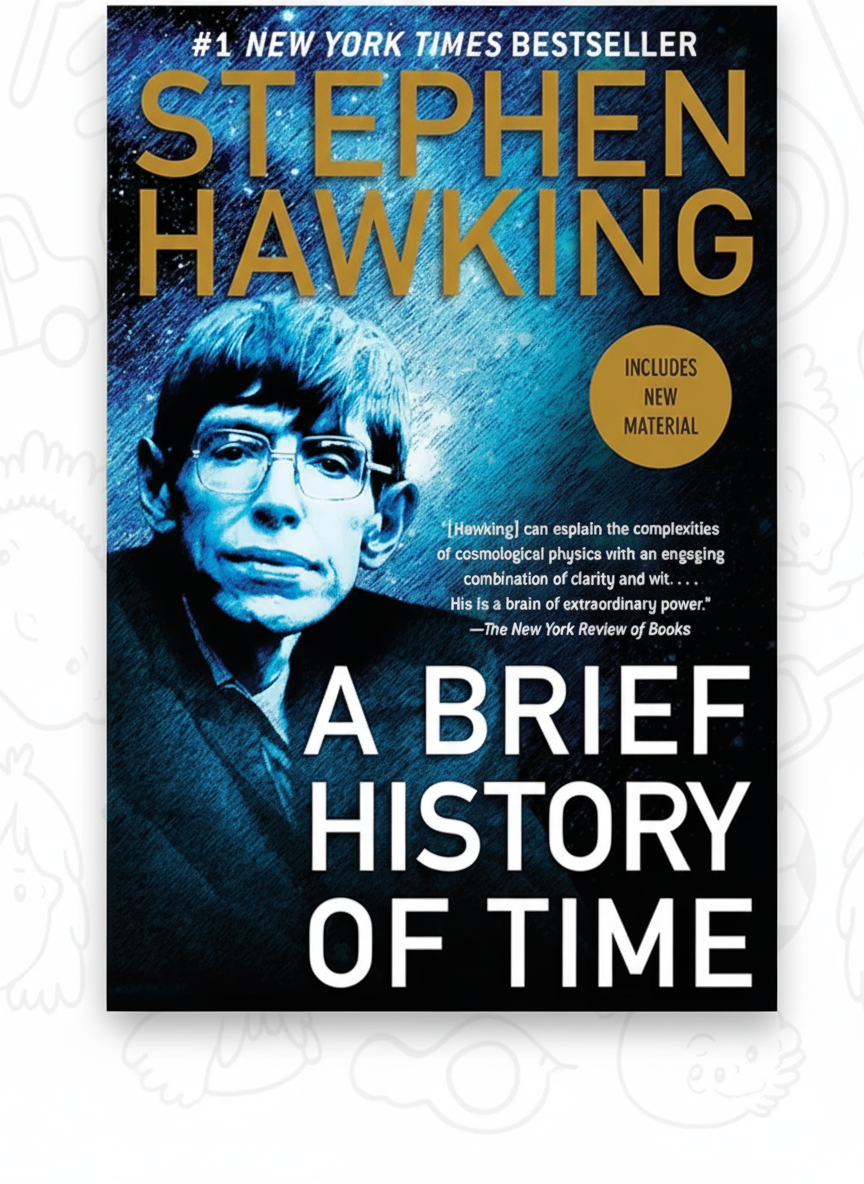
A Brief History of Time
A Brief History of Time takes you on a journey through the most profound questions humanity has ever asked: How did the universe begin? What is time? Are black holes real? Will the universe expand forever, or could it collapse? Stephen Hawking presents these complex topics with remarkable clarity, making them accessible while keeping the wonder of discovery alive. The book doesn’t just give facts it tells the story of scientific progress, showing how brilliant minds across history have shaped our understanding of reality.
Theories
One of the strongest reasons to read A Brief History of Time is its balance between simplicity and depth. Hawking explains difficult theories like relativity and quantum mechanics in a way that feels engaging rather than intimidating. You don’t need to be a scientist to follow along. Instead, the book uses real-world examples, thought experiments, and simple explanations to guide you step by step. That’s why A Brief History of Time remains one of the most recommended science books for beginners and lifelong learners alike.
Major Highlights
A major highlight of A Brief History of Time is its exploration of black holes mysterious regions where gravity becomes so strong that even light cannot escape. Hawking famously contributed to this field, and his explanations help readers understand why black holes are not just science fiction, but fundamental parts of our universe. The book also explores the Big Bang, the expansion of the universe, and the nature of time itself topics that can change how you see the world around you.
Beyond the science, A Brief History of Time is deeply philosophical. It invites readers to reflect on existence, destiny, and the laws that govern everything. Hawking asks whether the universe has a purpose, whether time has a beginning and an end, and what it would mean to discover a “theory of everything.” These questions make the book powerful, because it connects science to human curiosity and the timeless desire to understand the unknown.
The writing style of A Brief History of Time is another reason it stands out. Hawking writes with humor, warmth, and a sense of awe. Even when discussing complicated ideas, he keeps the tone conversational and engaging. This makes the book feel less like a textbook and more like a guided tour of the cosmos by one of the greatest minds of our time. Readers often say that A Brief History of Time makes them feel smarter, more curious, and more connected to the universe.
This book is also a valuable addition for students and educators. Whether you’re studying physics, astronomy, philosophy, or general science, A Brief History of Time provides a strong conceptual foundation. It helps readers build scientific thinking, understand major theories, and develop a lifelong interest in learning. Many teachers recommend it as a companion to school or university science courses because it makes hard concepts easier to grasp.
A Brief History of Time is a perfect gift for anyone who loves knowledge, discovery, or big ideas. It suits teens exploring science for the first time, adults returning to learning, and even experienced readers who want a beautifully written refresher on the universe. The book has remained popular for decades because its themes are timeless and its explanations remain relevant every time new discoveries are made.
If you want a book that expands your mind and helps you understand the universe in a meaningful way, A Brief History of Time deserves a top place on your shelf.
Bring home A Brief History of Time today and start your journey through space, time, and the deepest questions ever asked.